

Appearance
Curve fitting
The voltage response of a battery following a charge or discharge pulse is governed by electrochemical processes that occur over different time scales. As the battery relaxes toward its equilibrium state, the terminal voltage changes gradually rather than instantaneously. This relaxation behaviour provides valuable information about the dynamic characteristics of the battery.
Curve fitting is the process of finding a mathematical function that closely represents the measured voltage relaxation curve. By fitting an appropriate model to the experimental data, the dynamic parameters of the second-order Thevenin Battery Model can be identified.
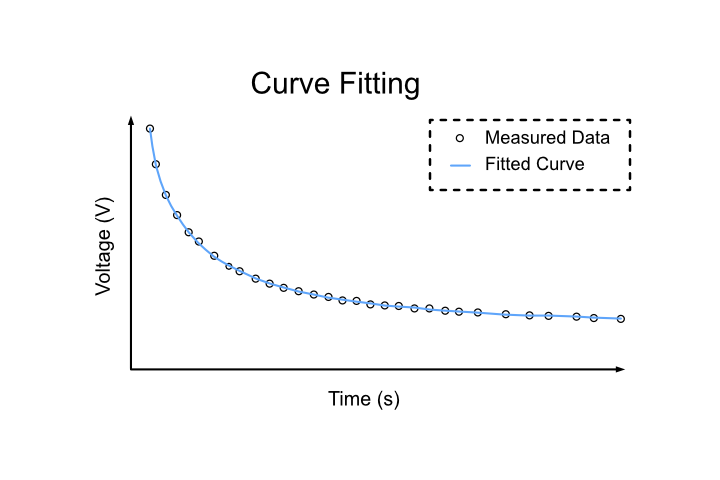 Figure 6.6: Measured voltage relaxation curve with fitted response.
Exponential relaxation
After a current pulse is removed, the transient voltages associated with the RC branches decay exponentially with time. This behaviour is characteristic of resistor-capacitor networks and forms the basis of parameter identification for the Thevenin model.
For a second-order Thevenin model, the relaxation voltage is represented by two exponential terms corresponding to the fast and slow polarization processes.
The voltage response can therefore be expressed as
where
is the equilibrium Open Circuit Voltage, and are the amplitudes of the fast and slow polarization voltages, and are the corresponding relaxation time constants.
The first exponential term represents the rapid polarization process immediately following the current pulse, while the second term represents the slower electrochemical processes that continue over a longer period.
Time constants
Each RC branch is characterized by a time constant defined as
For the second-order Thevenin model,
The time constants determine the rate at which the transient voltages decay during the relaxation period. Smaller time constants produce a faster voltage response, whereas larger time constants result in a slower relaxation.
Parameter estimation
Curve fitting determines the values of the exponential coefficients (
Once these quantities have been identified, the resistance and capacitance values of the second-order Thevenin Battery Model can be calculated using the relationships presented in the previous sections.
The identified parameters describe the dynamic electrical behaviour of the battery at a particular operating condition. Since battery behaviour changes with State of Charge and temperature, parameter identification is repeated over the battery's operating range to construct parameter maps.