

Appearance
What is State of Charge (SoC)?
State of Charge (SoC) represents the amount of charge remaining in a battery relative to its rated capacity. It is commonly expressed as a percentage, where 100% indicates a fully charged battery and 0% indicates a fully discharged battery.
The SoC of a battery can be expressed as
where
is the remaining charge stored in the battery. is the rated battery capacity.
The amount of remaining charge changes continuously as the battery is charged and discharged. Consequently, the SoC decreases during discharge and increases during charging, reflecting the battery's available energy.
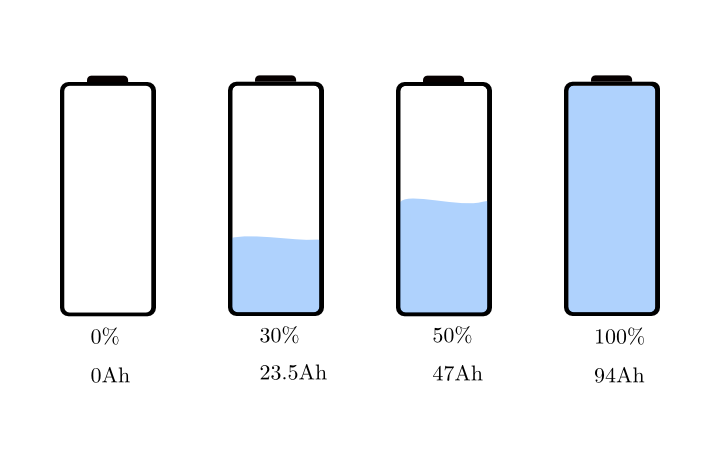
Figure 2.5: Illustration of State of Charge representing the remaining available charge in a battery.
Why is SoC important?
SoC is one of the most important parameters for monitoring the operating condition of a battery because it indicates the amount of usable energy available for operation.
Accurate knowledge of SoC enables reliable prediction of the remaining operating time or driving range, prevents overcharging and overdischarging, improves energy management, and helps extend battery life.
Unlike voltage, current, and temperature, SoC cannot be measured directly using a physical sensor. Instead, it must be estimated from measurable battery signals together with mathematical models.
The following chapter explains why estimating SoC is challenging and introduces the modelling approaches used to estimate it accurately.