

Appearance
What is a battery?
A battery is an electrochemical device that converts stored chemical energy into electrical energy through electrochemical reactions.
A battery consists of one or more electrochemical cells connected together to provide the required voltage, capacity, and power for a specific application. Depending on the application, cells may be connected in series, parallel, or a combination of both.
The electrical behaviour of a battery depends on several factors, including its chemistry, temperature, operating current, and State of Charge (SOC). These factors influence the battery voltage, available capacity, internal losses, and transient response during operation.
Battery cell
A battery cell is the smallest electrochemical unit capable of storing and delivering electrical energy. Each cell contains four primary components: a positive electrode (cathode), a negative electrode (anode), an electrolyte, and a separator.
During discharge, electrochemical reactions at the electrodes generate a potential difference that drives electrons through the external circuit, while ions move through the electrolyte to maintain charge balance. During charging, these reactions are reversed, allowing the battery to store electrical energy as chemical energy.
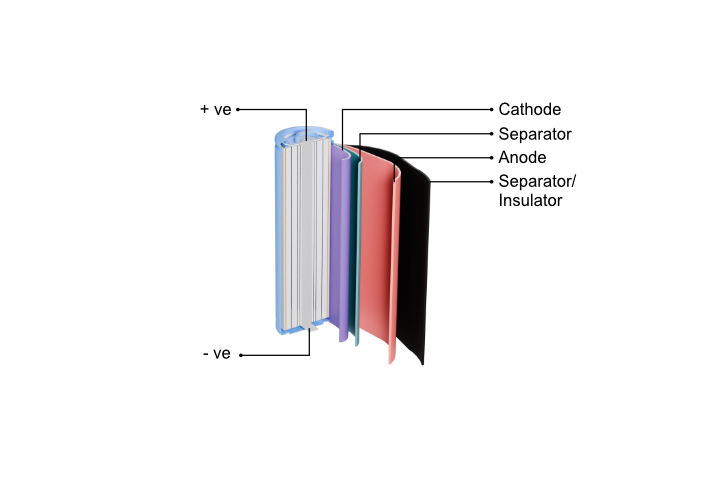
Figure 2.1: Structure of a typical battery cell showing the cathode, anode, separator, and electrolyte.
Understanding the structure and operation of a battery cell provides the foundation for the battery modelling, parameter characterization, and State of Charge estimation techniques discussed in the following chapters.