

Appearance
Hybrid Pulse Power Characterization (HPPC) test
The Hybrid Pulse Power Characterization (HPPC) test is performed to evaluate the dynamic electrical behaviour of a battery under changing load conditions. Unlike the Open Circuit Voltage (OCV) test, which measures the battery at equilibrium, the HPPC test examines how the terminal voltage responds when current is suddenly applied or removed.
During the test, the battery is subjected to a sequence of controlled charge and discharge current pulses. Each pulse is followed by a rest period, allowing the battery voltage to recover toward its equilibrium value before the next pulse is applied.
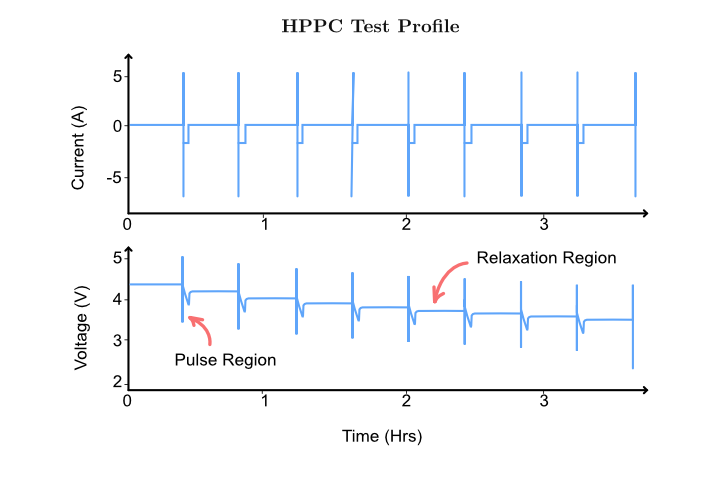 Figure: Typical HPPC current and voltage profile.)
The current pulse produces two distinct voltage responses:
- An instantaneous voltage change caused by the battery's internal resistance.
- A gradual voltage recovery caused by electrochemical polarization within the battery.
These voltage characteristics provide the information required to describe the dynamic behaviour represented by the resistor-capacitor (RC) networks in the Thevenin Battery Model.
To characterize the battery over its complete operating range, the HPPC test is repeated at multiple States of Charge. This allows the electrical behaviour of the battery to be measured under different charge conditions.
The recorded current, voltage, and time data obtained from the HPPC test form the basis for determining the dynamic parameters of the Thevenin Battery Model in the next chapter.