

Appearance
Second-order Thevenin model
Although the first-order Thevenin model captures the primary electrical behaviour of a battery, practical batteries exhibit multiple electrochemical processes that occur over different time scales. A single RC network cannot accurately represent both fast and slow polarization effects during dynamic operating conditions.
To improve modelling accuracy, the second-order Thevenin model introduces a second resistor-capacitor (RC) network. This additional branch enables the model to represent two independent polarization processes simultaneously, resulting in a more accurate prediction of the battery's transient voltage response.
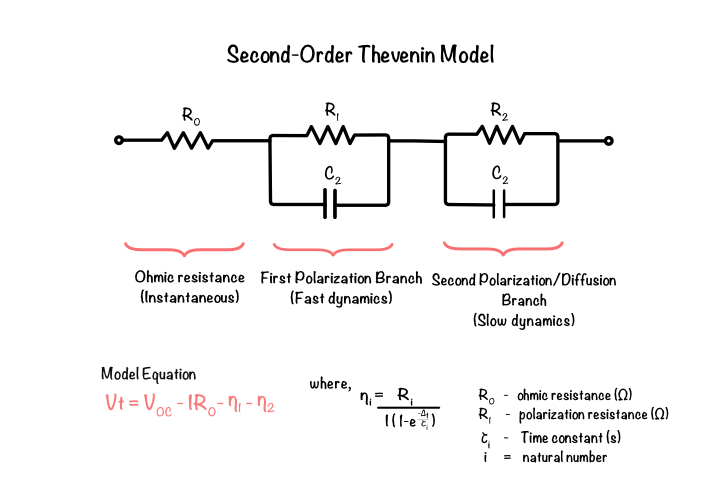
The second-order model consists of:
- Open Circuit Voltage (OCV)
- Ohmic resistance (
) - First RC branch (
, ) - Second RC branch (
, )
The first RC branch models the faster polarization dynamics that occur immediately after a change in current. The second RC branch represents slower electrochemical processes that continue to influence the terminal voltage over a longer period.
Polarization resistance (
The resistance
Polarization capacitance (
The capacitance
By combining two RC networks, the second-order Thevenin model provides a significantly better representation of the voltage response of lithium-ion batteries during rapidly changing load conditions while maintaining relatively low computational complexity.
For this reason, the second-order Thevenin model is widely used in Battery Management Systems and forms the battery model adopted throughout this manual.