

Appearance
Equivalent Circuit Model
An Equivalent Circuit Model (ECM) approximates battery electrical behaviour with circuit elements instead of solving detailed chemistry. It uses voltage sources, resistors, and capacitors to reproduce the voltage response during charging and discharging.
ECMs are preferred for battery management because they are:
- simple to compute
- suitable for real-time use
- accurate enough for state estimation
The Thevenin ECM balances simplicity and accuracy, making it common in State of Charge estimation and Battery Management Systems.
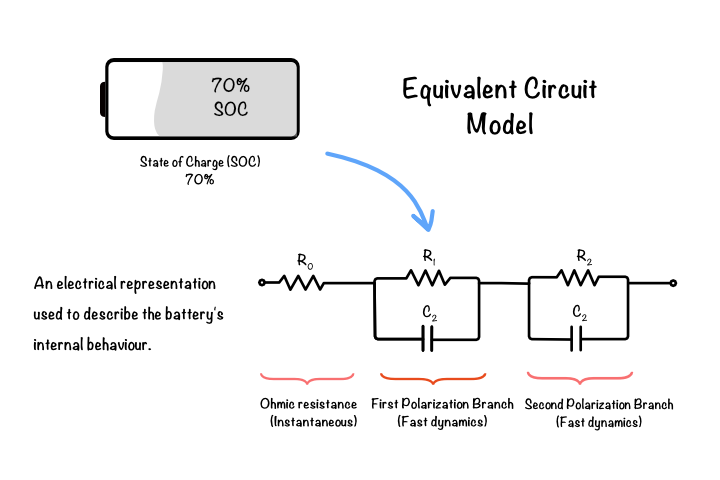 Figure 4.1: Equivalent Circuit Model
The Thevenin Battery Model
The Thevenin model represents a battery as an open circuit voltage (OCV) plus resistive and capacitive elements that capture instantaneous and transient voltage behaviour.
The first-order Thevenin model includes:
- OCV source
- ohmic resistance (
) - one RC network
For faster-changing loads, the second-order model adds another RC branch to capture slower polarization effects. This improves transient voltage accuracy while keeping the model computationally efficient.
The second-order model contains:
- OCV source
- ohmic resistance (
) - first RC branch (
, ) - second RC branch (
, )
Each element reflects a specific battery voltage behaviour during charge and discharge.