

Appearance
First-order Thevenin model
The first-order Thevenin model is one of the simplest Equivalent Circuit Models used to represent the electrical behaviour of a rechargeable battery. It combines an ideal voltage source with resistive and capacitive elements to reproduce both the instantaneous and transient voltage response observed during battery operation.
The model consists of four main components:
- Open Circuit Voltage (OCV)
- Ohmic resistance (
) - Polarization resistance (
) - Polarization capacitance (
)
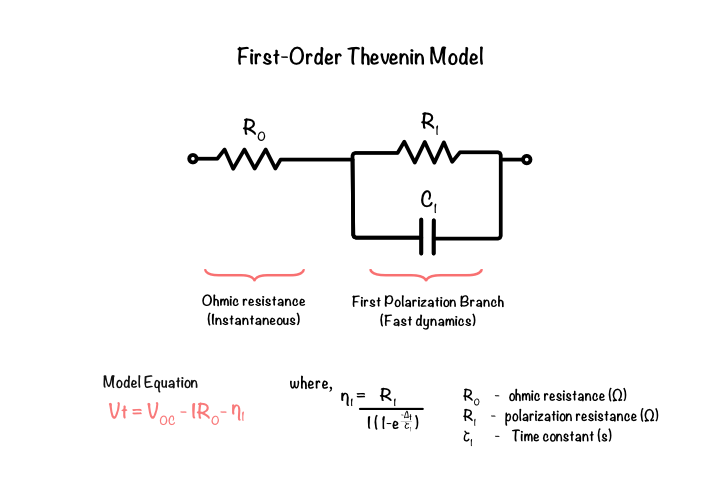 Figure 4.2: First-Order Thevenin Model
Open Circuit Voltage (OCV)
The Open Circuit Voltage represents the equilibrium voltage of the battery when no current is flowing. It depends primarily on the battery's State of Charge and serves as the main voltage source in the model.
During battery operation, the OCV changes as the amount of stored charge changes. The relationship between OCV and SoC is obtained experimentally through Open Circuit Voltage characterization.
Ohmic resistance (
The resistance
Whenever current flows through the battery, an immediate voltage drop occurs according to Ohm's law. This effect is represented by
Polarization resistance (
The resistance
Unlike the instantaneous voltage drop produced by
Polarization capacitance (
The capacitance
Together,
The first-order Thevenin model provides a good representation of battery behaviour under many operating conditions. However, practical batteries often exhibit multiple polarization processes with different response times that cannot be accurately represented by a single RC network.